2025 Annual Report
Opening Letter

Dear Friends and Partners,
2025 was not an easy year for communities or for the organizations that choose to stand with them. Resources tightened across the development sector. In several contexts where Tostan works, insecurity and fragility placed additional pressure on communities already navigating difficult conditions. More broadly, long-standing assumptions about how development is financed, who defines its priorities, and what counts as lasting progress are being questioned, and rightly so.
What this year confirmed, once again, is that sustainable change does not depend only on favorable conditions. It depends on people’s collective capacity to understand their realities, organize around shared priorities, and act with purpose.
That conviction is at the heart of Tostan’s work. It does not begin with predefined solutions. It begins with education in local languages, through dialogue, reflection, and a shared exploration of rights, responsibilities, and what communities want for their future. That process strengthens individuals. Women, men, and young people build knowledge, confidence, and the capacity to lead. Those individual shifts become collective. Communities organize, define priorities, and take action. Over time, those actions shape the wider territory: more children in school and registered at birth, stronger local governance, reduced conflict, improved access to health services, and more inclusive local economies.
This is the pathway behind the results in this report.
Across Senegal, The Gambia, Guinea-Bissau, Guinea, and Mali, communities used this process in 2025 to address challenges that carry real weight in daily life. In Kédougou, young people from Bassari communities defined a response to mental health grounded in their own cultural practices, without waiting for an external expert to name the problem or design the solution. In Mali, community peace committees resolved land disputes and household tensions before they escalated, extending their reach to 130 communities beyond those directly engaged in the program. In Senegal and Guinea-Bissau, women and youth turned learning into economic initiative: managing community loan funds with a 95% repayment rate, financing micro-projects, and strengthening their participation in local markets. I also want to recognize our teams across the region, whose steady presence alongside communities made this work possible in a year marked by real uncertainty and strain.
These results matter beyond the communities where they were produced. The challenges communities addressed in 2025: school inclusion, civil registration, maternal health, conflict prevention, economic resilience, and the protection of girls, are also the challenges that national development agendas across the region have committed to address. Senegal's Vision 2050 places human capital, social equity, territorial development, and good governance at the center of national transformation. The Gambia's Recovery-Focused National Development Plan (RF-NDP) prioritizes education, local governance, civil registration, and women's empowerment. Mali's National Strategy for Emergence and Sustainable Development (SNEDD) links peace, decentralization, citizenship, and human development. Guinea-Bissau's national cooperation framework centers democratic governance, access to social services, and structural economic transformation.
Tostan's contribution is not to substitute for public systems. It is to strengthen the community-level conditions, participation, trust, local organization, and sustained agency that public systems need in order to work.
We close this year with gratitude to the partners and donors who sustained this work, and above all to the communities who continue to lead it. We also close with confidence: in communities that keep moving forward with dignity and determination, and in the young people whose ideas, courage, and commitment are helping shape more just and more resilient futures.
Sobel Aziz Ngom


Chief Executive Officer, Tostan

2025 Results at a Glance
Learning Reached People

engaged in Tostan’s education programs across West Africa
People
reached through community-led awareness-raising activities
Communities Took Action

identified as out of school were enrolled through community-led initiatives
identified

in partner communities attended prenatal consultations
than 14,000 children
were vaccinated through community mobilization

identified as unregistered at birth were registered
Governance and Citizenship

local elected officials trained in local governance and public accountability in Senegal and The Gambia
How Change Happens
The process begins with education: in local languages, through dialogue and facilitation, grounded in human rights and shared responsibilities.
Education as the starting point
Education here is an invitation to reflect, to question, and to imagine what change is possible.
That starting point carries more weight than it might appear. When people learn in the language they think and dream in, when they are invited to examine their own realities rather than receive someone else’s diagnosis, something shifts that goes beyond knowledge. Women, men, and young people develop the confidence to speak, the capacity to analyze, and the willingness to lead. They begin to see themselves as actors in their own development.
Communities act on their own priorities
In the remote and underserved communities where Tostan works, women, men, and young people form or reinforce management committees, define shared priorities, and launch initiatives around challenges they have identified themselves. They determine what gets done, in what order, and with whom. These are precisely the communities that public systems most consistently struggle to reach: households that fall outside administrative data, women and girls excluded from formal decision-making, and youth without access to economic opportunity.
Local action strengthens public systems
As communities act, the effects extend into local public life. Children out of school get identified and enrolled. Births that went unregistered get recorded, improving the civil registration data that planning ministries depend on. Pregnant women are connected to health services. Land disputes find structured resolution before they escalate. Local elected officials engage more effectively with the communities they represent. Public institutions gain a stronger local foundation for delivering on the commitments governments have made.
Change spreads through social networks
This is what makes the results sustainable. When education builds on knowledge communities already hold, and when it strengthens collective capacity rather than individual compliance, change does not depend on the continued presence of an external actor. It spreads through social networks. It survives funding gaps. And it generates forms of local accountability that no external monitoring system can replicate. This is what community-led development looks like.
What Defined 2025
Tostan Kept Evolving
In 2025, Tostan continued to refine how it supports community-led change. This included adapting the Community Empowerment Program curricula for SolarSPELL, a solar-powered offline digital library designed for low-connectivity settings and accessible via mobile phone. The adaptation also advanced broader program revision to integrate new knowledge around relational wellbeing and mental health. The goal is a model that stays rooted in local-language learning, dialogue, reflection, and community ownership, while remaining relevant and accessible to the realities rural communities face today. For governments and partners working in areas with limited infrastructure, that combination matters: it means the approach can reach the communities that most development programming leaves behind.
The Model Kept Spreading
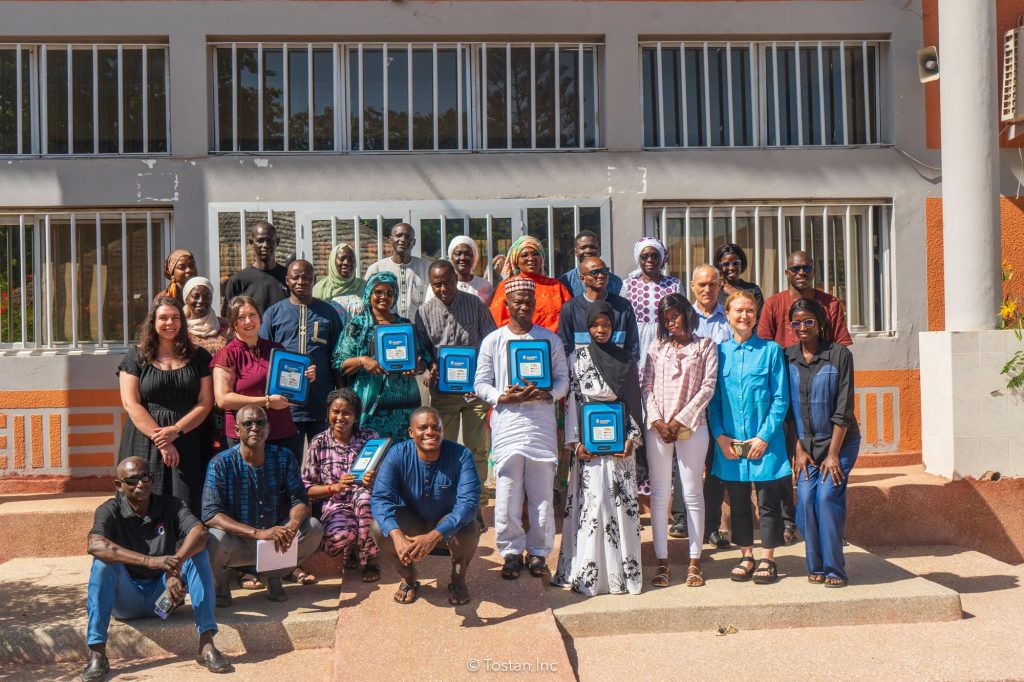
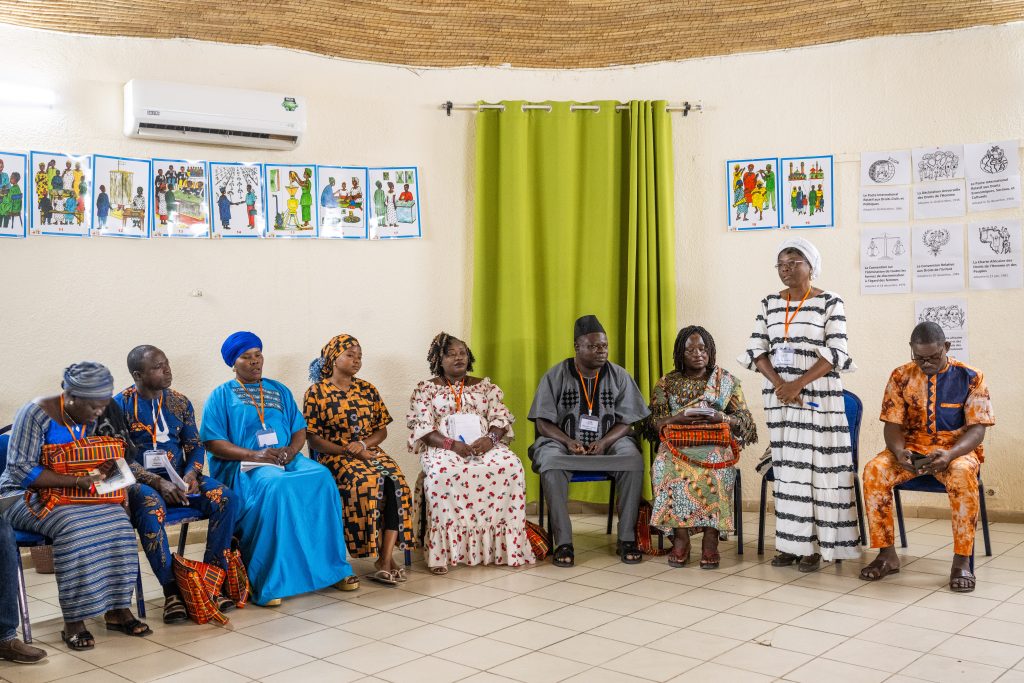
In 2025, Tostan's methodology continued to expand through training, mutual learning, and institutional partnerships. In northern Benin, 22 local organizations working in fragile, high-risk areas adapted Tostan’s approach, combining social cohesion work with attention to the mental health needs of women, youth, and communities bearing the heaviest cost of instability. In Ethiopia's Omo Valley, participants from five indigenous communities engaged with Tostan’s model, leaving with concrete action plans and newly established community management committees. In Accra, 30 civil society actors from West and East Africa sought out Tostan's methodology as a practical framework for social norms change and community-led transformation. Seminars also took place in Sierra Leone, Côte d'Ivoire, Senegal, and The Gambia.
What these experiences reflect is a distinction that matters for how institutional partners think about scale. Organizations are not seeking to reproduce Tostan's program as designed. They are drawing on its methodology to address their own contexts, adapting tools, sequencing, and content to specific social realities.
Since 2015, 1,025 practitioners from 50 countries have learned about Tostan’s approach and methodology in our sharing and mutual learning seminars. The more demanding question is what happens when those practitioners carry the approach forward without Tostan's direct presence.
A Global Fund for Children learning review provides significant evidence on that point. Among organizations that applied Tostan’s methodology independently in Liberia and Sierra Leone, reviewers documented stronger leadership by women and youth, reduced conflict and gender-based violence, improved school attendance, and communities reexamining harmful practices through dialogue grounded in their own values.
Training Participant Voices
“What I experienced through Tostan’s training was a shift in how we approach development work. This training changed how we design programs. Instead of applying predefined approaches, we now work with communities to define priorities and build ownership from the outset. This makes our interventions more relevant and sustainable.”
Songaye George Buannie,
Male Engagement and GBV Specialist, Sierra Leone, 2025
“Although we often enter communities with good intentions, our approach sometimes leaves critical gaps. This training emphasized allowing communities to define their own vision and identify the resources they already possess. Meaningful development happens with communities, not for them. At Caritas Ghana, we plan to cascade this approach to our local substructures so that those working directly with communities can integrate it into their daily work.”
Richard Nyihaba Akrugu,
Caritas Ghana, Ghana, 2025
Our Impact
caregivers in parenting education
out-of-school children enrolled
unregistered children registered
Early Childhood, School Access & Civil Registration
Children enrolled
62
Birth certificates issued
63
Across 76 communities in Guinea-Bissau, The Gambia, and Mali, parents and caregivers participated in learning sessions on early brain stimulation, child development, and social norms — conducted in local languages through dialogue. Monitoring documented changes in daily caregiving: fathers and mothers speaking more with their children, reading at home, reviving the practice of storytelling.
Communities that can see who is being left out — and act through existing institutions to close that gap — are contributing to the accuracy of data that national planning ministries use to allocate budgets.
people in learning sessions
direct program communities
additional communities reached
Conflict Prevention in Mali
Women leading mediation
↑ significant
In Mali, the retreat of state authority left communities managing tensions over land and shared resources with little institutional support. 3,356 people across 30 communities engaged in learning sessions on dialogue and collective responsibility. Women emerged as leaders of conflict mediation processes from which they are routinely excluded.
Community Peace Committees addressed land disputes and intercommunal friction through deliberation, before they could harden into something more difficult to address. Through peer outreach, their reach extended to 130 additional communities — none of which participated directly in the program.
When disputes are resolved through deliberation, social trust deepens and communities grow more capable of managing the next conflict that arises.
people accessing microloans
repayment rate
in seed capital placed under community management
Economic Inclusion across 3 Countries
Repayment rate
95
Women & youth participants
majority
Community reach multiplier
x6
Across 100 communities in Senegal, The Gambia, and Guinea-Bissau, approximately $112,000 in seed capital placed under community management enabled 2,580 individuals to access small loans for agricultural processing, small trade, and food production. Capital circulated an average of six times within the same communities.
In Guinea-Bissau, grants totaling $59,000 through the ECOWAS Fund supported 406 individuals including 303 women and girls, financing micro-projects and contributing to household income and local economic stability.
One dollar invested in a community-managed fund produced six rounds of economic activity before leaving the system. That is the financing efficiency case for community-governed capital.
communities publicly committed
people engaged in Guinea-Bissau
countries with formal declarations
GBV Prevention & Protection
Communities with formal commitment
95
Senegal: public declarations
75 communities
In 2025, 75 communities in Senegal declared the abandonment of child marriage, female genital cutting, and gender-based violence in the presence of administrative, traditional, and religious authorities — with monitoring structures and defined roles for identifying risks and engaging families before situations escalate.
In Guinea-Bissau, community-led campaigns reached 7,226 people. Women living with obstetric fistula received surgery, income support, and accompaniment back into community life through a partnership with UNFPA — all resumed economic activity.
Communities that can see who is being left out — and act through existing institutions to close that gap — are contributing to the accuracy of data that national planning ministries use to allocate budgets.
young people supported
community-designed initiative
Oct. 2025
launch date
Youth Mental Health in Kédougou
In Kédougou, young people from Bassari communities identified mental health as a collective priority — before any program had named it as one. Through engagement in Tostan’s education sessions, they proposed a response rooted in their own cultural practices, without waiting for an external framework to define either the problem or the solution.
The Art of Wellbeing, launched in October 2025 in collaboration with the Being Initiative and with support from Grand Challenges Canada, supports 200 young people through dance, music, and visual arts, combined with facilitation that deepens understanding, reduces stigma, and sustains dialogue on mental health.
What shifted first was not a behavior or an indicator. It was the capacity of young people to name a challenge that had previously gone unspoken and claim collective ownership of a response.

women in direct education sessions
total direct & indirect participants
skills training programs
Reintegration of Women in Detention
Women in direct training (tailoring, food, production)
339
Family mediation sessions conducted
ongoing
In Senegal, leaving detention does not end the conditions that made reintegration difficult. Stigma limits employment. Family ties, often strained during incarceration, do not repair themselves. In 2025, 339 women participated in education sessions and practical training in food processing, tailoring, and small-scale production.
Beyond direct participants, 1,368 additional people were reached: family members in mediation, prison guards trained for reintegration support, and former detainees. Upon release, selected participants received start-up capital to begin income-generating activities.
Communities that can see who is being left out — and act through existing institutions to close that gap — are contributing to the accuracy of data that national planning ministries use to allocate budgets.
In the News
In 2025, Tostan’s work and the communities it partners with were featured by 86 national and international media outlets in French, English, and local languages. Coverage highlighted girls’ education, women’s health, the abandonment of harmful practices, and social cohesion, reflecting growing recognition that community-led transformation matters not only in development practice, but in wider public debate.
Country Insights
From Community Action to Public Value
Community Capacity and the Conditions for Public Delivery
Senegal's Vision 2050 is built on a series of interdependencies. Human capital investment depends on population data that is accurate, complete, and current. Territorial development depends on communities that can participate actively in local governance. Social equity depends on financial mechanisms that reach the households formal systems do not. Each of these dependencies rests on the same foundation: communities with the capacity to act on their own priorities, document their own realities, and engage with public institutions.
In partner communities across Senegal, that capacity produced concrete results in 2025. In communities where Tostan's program runs, women, men, and young people have developed the confidence to analyze their own realities and act collectively. Community members identified children who had never been officially recorded and organized to register them through state channels. Five hundred and thirty-seven children received birth certificates, giving them legal identity, access to school enrollment, eligibility for public health services, and a place in the population data that determines how resources are allocated in their territories. In the same communities, 760 children identified as out of school were enrolled. Both results reflect communities that have built the collective capacity to see who is being left out and to act on it through existing public institutions.
In 25 dairy-producing communities, the MELITEJI-WASU project strengthened that same capacity through a different entry point. Women and youth built literacy, numeracy, project management, and collective decision-making skills that translated directly into stronger participation in local markets. In a separate group of 20 communities, women and youth accessed loans through community-managed funds, expanding or creating businesses with a 95 percent repayment rate. The repayment performance is the result worth examining. It reflects communities that have built the literacy, numeracy, and collective accountability to manage financial resources reliably over time. For Vision 2050's territorial economic resilience agenda, that governance quality is what determines whether financial inclusion produces sustainable results or remains a one-cycle intervention.
The education process also supported communities in building their own child protection monitoring structures and youth civic engagement initiatives, extending public commitments into territories where institutional presence is limited.
Across these dimensions, the results reflect a community-level dynamic that national development strategies depend on. Communities that can organize, document, and act on their own priorities create the local foundation that allows public investment to go further. Where that foundation exists, the distance between a national commitment and its local reality closes. Where it does not, it tends to persist.
Closing the Distance Between Citizens and Institutions
The Gambia's Recovery Focused-National Development Plan 2023-2027 identifies a specific governance problem. Local authorities received new powers and resources from the central government, but not the training or institutional support needed to use them effectively. The plan commits explicitly to training local governance stakeholders, strengthening community-based participatory planning and budgeting, and assessing Ward and Village Development Committees for functionality. Communities, equally, need the capacity to engage elected officials as informed actors, not only as recipients of decisions made above them.
In 2025, 43 ward councilors were trained in participatory planning and budgeting, transparency, accountability mechanisms, and the roles of local actors in governance. Those are precisely the competencies the RF-NDP identifies as insufficient at the local level. Councilors left with practical tools for engaging the communities they serve.
The RF-NDP places equitable access to quality education and improved early childhood outcomes at the center of its human capital commitments. Those commitments depend on what happens at home before a child reaches a classroom. When caregivers understand how brain stimulation, responsive interaction, and structured play shape cognitive and social development in the first years of life, the household becomes the foundation on which formal education builds. In 2025, 1,181 parents and caregivers in Tostan's partner communities participated in learning sessions on early childhood development conducted in local languages. What shifted was their understanding of their own role in that process.
In 2025, Tostan's work in The Gambia moved on both fronts the RF-NDP identifies as critical. Ward councilors built the practical knowledge to govern accountably, and caregivers developed the understanding that shapes children's learning before formal schooling begins. The RF-NDP's targets for local governance and human capital development rest on local officials who manage resources transparently and govern inclusively, and on an education system that prepares the next generation to find and build solutions to The Gambia's own development challenges.
Where Institutions and Communities Meet
In Bafatá, Gabú, and the remote communities where Tostan operates, geographic distance and poor infrastructure make it hard for public services to reach the people who need them most. In 2025, three results from those territories show what becomes possible when community capacity and institutional support work together.
Many schools across Guinea-Bissau rely on community teachers who started teaching because no qualified teacher ever arrived, who had no formal pedagogy training, and who remain the only educator their village has known. In 2025, Tostan and the Ministry of Education worked together to support 20 of these teachers. For the first time, they received training on classroom practices to engage students more effectively, children's rights, early childhood development, and how to monitor children's learning progress. The Ministry now has a tested model for how community-based educators, when supported through a public partnership, can bring national education commitments to territories where recruiting qualified staff and building new schools takes years.
Beyond education, Tostan participated in a consortium led by SWISSAID, alongside other partners, implementing the project Brilliant Professional Opportunities and Empowerment of Youth and Women for Community-Led Sustainable Development, supported by the German Government through the ECOWAS Stabilisation and Development Fund for Fragile Regions. The project focuses on human rights education, agroecology, and the economic empowerment of women and youth in Bafatá and Gabú. As part of that work, Tostan directly supported more than 400 individuals, the majority women and girls, to finance income-generating projects, and trained over 2,000 people in agroecology and agricultural product processing.
That same community reach extended into health. Community Management Committees trained through Tostan's program in the Bafatá region identified women living with obstetric fistula who had never accessed formal health services. Through a partnership with UNFPA Guinea-Bissau, those women received surgery, income support, and help reintegrating into community life, and all resumed economic activity. In areas where health workers rarely reach, community structures with the knowledge and trust to find the most isolated people are what make treatment possible at all.
Guinea-Bissau's national cooperation framework commits to equitable access to social services and structural economic transformation in the country's most remote and fragile territories. Both commitments depend on communities that can absorb external resources productively, extend the reach of public institutions, and connect isolated individuals to services they cannot access alone.
The 2025 results tell a consistent story across three sectors. Teachers received training through a Ministry partnership for the first time. Economic investments generated results in some of Guinea-Bissau's most fragile territories. Women living with fistula, unknown to the formal health system, were found and connected to treatment. In each case, community readiness built through education was what allowed institutional partners to be effective.
Community Resilience in a Fragile Territory
In Mali, the question communities faced was not how to engage with public institutions. It was how to organize collective life when those institutions were too distant to reach. Land disputes arose without public arbitration mechanisms nearby. Tensions between neighboring communities accumulated without forums for resolution. In remote areas where state presence has been limited, that responsibility fell to communities themselves, to local leaders, and to the structures that exist at the level where people actually live.
Mali's National Strategy for Emergence and Sustainable Development (NSESD) places peace, local governance, citizenship, and territorial resilience alongside human development as mutually dependent priorities. Stability creates the conditions for governance to function. Functional governance and active citizenship reinforce each other. Human development advances when all three hold at the same time.
In 30 communities across Mali, 3,356 people engaged in learning sessions on dialogue, collective responsibility, governance, and conflict prevention. Participants built the capacity to listen across differences, deliberate under tension, and act together on challenges they had identified themselves. Women emerged as leaders of conflict mediation processes from which they were usually excluded. From that foundation, communities organized. Peace Committees trained in structured mediation took on land disputes, household tensions, and intercommunal friction, addressing them through deliberation before they could harden into something more difficult to address. Through peer outreach and intercommunity exchange, their reach extended to 130 additional communities that had not participated directly in any program. Public declarations, signed by administrative, traditional, and religious authorities, connected what communities had built to what local governance could recognize and sustain.
When disputes are resolved through deliberation, social trust deepens and communities grow more capable of managing the next conflict that arises. Peace Committees that spread their methods to neighboring communities through existing social networks, and that carry the recognition of local authorities, become part of how a territory governs itself rather than a temporary response to a specific crisis. The SNED's territorial resilience commitments rest on exactly that kind of capacity taking root at the community level.
The 2025 results from Mali document grassroots peacebuilding that is incremental, relational, and self-reinforcing. In the Sahel, social cohesion is built in the spaces where people negotiate their differences, organize around shared responsibilities, and maintain the fabric that makes collective life possible. What the 2025 results show is that fabric holding.
About Tostan
Tostan is a non-profit organization that empowers communities to define priorities and lead their own development. Headquartered in Thiès, Senegal, Tostan operates in five West African countries and collaborates with partners across Africa and globally.
Tostan implements the Community Empowerment Program, an African-inspired education program grounded in human rights and shared responsibilities. Through participatory methods in local languages, the program strengthens communities’ capacity to analyze their context, organize collectively, and engage with public institutions. Over the past three decades, Tostan’s education program has reached over seven million people, contributing to measurable progress in good governance, social transformation, and human development.
As a technical partner, Tostan collaborates with African governments and development actors to advance priorities including education, health, gender equality, child protection, youth employment, and social cohesion.
Tostan also trains development practitioners, including grassroots NGOs and government leaders, in its education model through a sharing and mutual learning approach.
Financials
As a part of our commitment to transparency, Tostan publishes comprehensive financial records and data on its website as soon as they are finalized. Please read our Audited Annual Financial Statements and our Annual Form 990 submission.
The C-Suite